
When it comes to protecting your finances and your family, adding the right rider to your life insurance policy can make a huge difference. Two of the most commonly confused options are the Critical Illness Rider and the Long-Term Care (LTC) Rider.
They sound similar—but they solve very different problems.
Let’s break it down in plain English so you can make the right decision.
🩺 What Is a Critical Illness Rider?
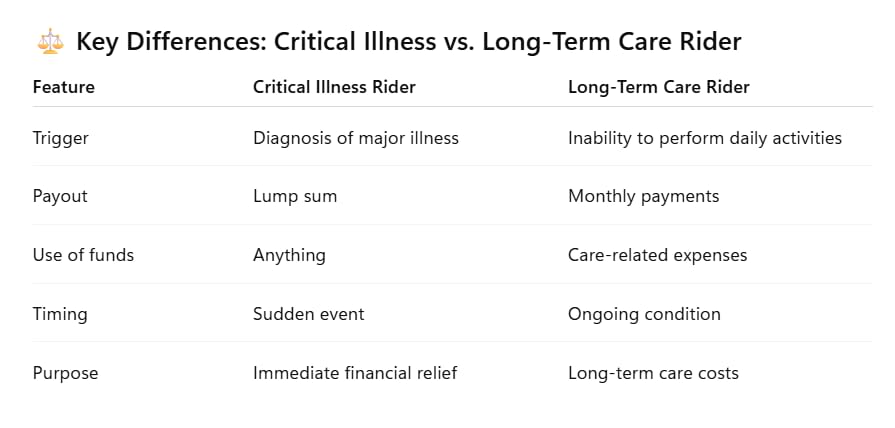
A Critical Illness Rider provides a lump-sum payout if you’re diagnosed with a major illness.
Covered conditions typically include:
- Heart attack
- Stroke
- Cancer
- Organ transplant
- Kidney failure
💰 How it works:
If you’re diagnosed with a covered condition:
- You receive a cash payout (tax-free in most cases)
- You can use the money however you want:
- Medical bills
- Mortgage or rent
- Lost income
- Travel or experimental treatments
👉 Think of this as “financial shock protection”
🏥 What Is a Long-Term Care Rider?
A Long-Term Care Rider helps cover the cost of extended care services when you can no longer take care of yourself.
It activates when you:
- Cannot perform 2 out of 6 Activities of Daily Living (ADLs):
- Bathing
- Dressing
- Eating
- Toileting
- Transferring
- Continence
OR
- Have a cognitive impairment (like Alzheimer’s)
💰 How it works:
- Pays out monthly benefits (not a lump sum)
- Covers:
- In-home care
- Assisted living
- Nursing home care
👉 Think of this as “extended care protection”
🧠 Real-Life Example
Scenario 1: Heart Attack at Age 50
With a Critical Illness Rider:
- You get a $50,000–$100,000 lump sum
- Helps cover:
- Time off work
- Medical bills
- Household expenses
Scenario 2: Alzheimer’s at Age 75
With a Long-Term Care Rider:
- You receive monthly payments (e.g., $3,000–$6,000/month)
- Covers:
- In-home caregiver
- Assisted living facility
🧩 Can You Have Both?
Yes—and in many cases, you should consider both.
Why?
Because they cover completely different risks:
- Critical Illness = unexpected diagnosis
- Long-Term Care = aging + extended care needs
👉 One handles the shock, the other handles the long-term burden
🎯 Which One Is Right for You?
Choose a Critical Illness Rider if you:
- Want cash flexibility
- Are concerned about cancer, heart attack, stroke
- Need income protection during recovery
Choose a Long-Term Care Rider if you:
- Are planning for retirement
- Want to avoid draining your savings
- Are worried about nursing home costs in California (which can exceed $100K/year)
📍 Why This Matters in California
In places like Orange County, Fullerton, Irvine, and Huntington Beach:
- Long-term care costs are extremely high
- Families often end up paying out of pocket
👉 Without proper planning, this can wipe out:
- Retirement savings
- Home equity
- Family wealth
💡 Pro Tip (From an Insurance Pro)
Most people make this mistake:
They focus only on death benefit… and ignore living benefits.
The truth is:
👉 You’re more likely to use living benefits than your life insurance payout.
🚀 Final Thoughts
- Critical Illness Rider = Immediate financial relief after diagnosis
- Long-Term Care Rider = Ongoing support for extended care
Both are powerful tools—but they serve different purposes.
If structured correctly, they can:
- Protect your income
- Preserve your assets
- Reduce stress on your family
📞 Need Help Choosing the Right Strategy?
Every situation is different—especially when it comes to:
- Age
- Health
- Budget
- Retirement goals
👉 Let’s build a plan that actually fits your life.
Text me at 714-231-0897 or call the office 714-893-7271