

4
If you’re exploring permanent life insurance, you’ve likely seen:
👉 Indexed Universal Life (IUL)
👉 Universal Life (UL)
They sound similar—but the way they grow your money and perform over time is very different.
This guide breaks it down so you (and your clients) can clearly understand which strategy fits best.
🧠 What Is Universal Life (UL)?
Universal Life (often called traditional UL) is a flexible permanent life insurance policy with a focus on:
- Stable, interest-based growth
- Adjustable premiums
- Lifetime coverage
How It Works:
- Your cash value earns a declared interest rate set by the insurance company
- You can adjust premiums and death benefit
- Growth is typically steady but lower
Best For:
✔ Conservative clients
✔ Long-term coverage focus
✔ Predictable (but modest) growth
📈 What Is an IUL?
IUL is a modern evolution of UL that adds:
- Market-linked growth (based on an index like S&P 500)
- A 0% floor (protection from losses)
- Caps on gains
How It Works:
- You don’t invest directly in the market
- The insurance company credits interest based on index performance
- You participate in gains (up to a cap) without downside risk
Best For:
✔ Growth + protection
✔ Tax-free retirement income
✔ Long-term wealth building
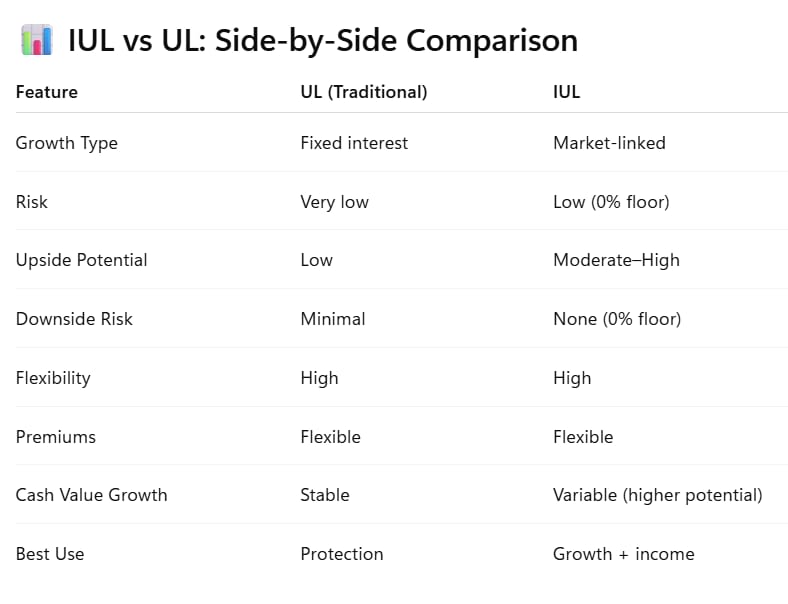
💡 The Key Difference (Simple Terms)
👉 UL = Slow, steady growth (like a savings account)
👉 IUL = Growth tied to market (with protection)
📉 Example (Simple Comparison)
UL Policy:
- 3–5% steady interest
- Predictable but limited growth
IUL Policy:
- 0% floor
- 6–8% average potential (depending on caps & indexing)
👉 Over time, IUL often builds more usable cash value
🏆 Why Many Clients in Orange County Prefer IUL
In areas like Orange County, clients are looking for:
✔ Better long-term growth
✔ Tax-free income strategies
✔ Protection from market crashes
👉 IUL checks all three boxes.
⚠️ When UL Might Be Better
UL may be a better fit if:
- You want simple, predictable growth
- You don’t care about maximizing cash value
- You want a low-cost permanent policy
🚀 When IUL Is the Better Strategy
IUL is ideal if you:
- Want higher long-term accumulation
- Are planning for tax-free retirement income
- Want market upside without losses
- Are okay with variability (within protection)
🧾 Pros & Cons Breakdown
UL Pros:
✔ Simple structure
✔ Stable interest crediting
✔ Lower cost (in some cases)
UL Cons:
❌ Lower growth potential
❌ May not keep up with inflation
❌ Less effective for income strategies
IUL Pros:
✔ Higher growth potential
✔ 0% floor protection
✔ Tax-free income potential
✔ Flexible design
IUL Cons:
❌ Caps limit upside
❌ Requires proper structuring
❌ Performance depends on index environment
❓ FAQ
Is IUL better than UL?
👉 For growth and income—yes.
👉 For simplicity—UL may be enough.
Can UL lose money?
👉 Typically no, but returns can be very low, especially in low interest environments.
Can IUL lose money?
👉 No—because of the 0% floor.
Which builds more cash value?
👉 Generally IUL over time, especially in long-term scenarios.
Can I switch from UL to IUL?
👉 Sometimes—through a 1035 exchange, depending on your policy.
🎯 Best Strategy (Advanced Planning)
Many high-income clients:
- Use UL for basic protection
- Use IUL for growth + tax-free income
👉 This creates a balanced approach:
- Stability + opportunity
📞 Get a Free Policy Review
If you already have a UL or are considering IUL:
✔ We’ll review your current policy
✔ Show side-by-side projections
✔ Help you optimize for tax-free income
💬 Final Thought
“UL protects your money quietly…
IUL gives your money a chance to work harder—without risking loss.”
📲 Text me at 714-231-0897 or call the office 714-893-7271
🌐 Serving Orange County & all of California